COLLIER: Batman’s Lessons Not Learned: Flock Cameras & ShotSpotter 

In Christopher Nolan’s 2008 film The Dark Knight, Batman has too much power.

Bruce Wayne’s research and development guy, Lucius Fox, played by Morgan Freeman, develops a technology that essentially allows Batman to “see” and hear throughout all of Gotham. In the film, it is more of a sonar-type ability, but for a Bat-man this is ideal! Freeman/Fox says to Batman, “This is wrong.” Batman responds that he has to find the bad guy, played excellently by Heath Ledger, and Freeman/Fox replies, “At what cost?” You can see a clip of the exchange on YouTube.

Quite literally, Batman made the choice to trade individual privacy for the safety of the populace. Yet, Batman, like Freeman/Fox, realized that this was a terrible idea and, spoiler alert, the device is set to destruct after its singular usage, rather than to allow a rise of a surveillance state.

Citizens around the United States are protesting the rampant use of Flock cameras. The cameras can read license plate numbers at high speeds and thus track the movements of our vehicles. These cameras, combined with increasingly high-quality facial recognition technology, make tracking individuals much easier and much more dangerous. In at least 12 states so far, police officers have been accused of misusing the technology for their personal use, including stalking of ex-wives and girlfriends. We also know that Flock’s executives misuse the cameras, and this was covered in a satirical but newsworthy manner by John Oliver in the last month.

Combine the Flock technology with the ShotSpotter technology, and we have cameras and microphones capable of recording video and sound stationed throughout our community. In Oakland, California, and elsewhere, ShotSpotter audio clips already appear in court cases, where audio clips recorded people shouting the nicknames of the shooter and, in another instance, a person shouting, ‘Why did you shoot me?’ The prescient use and misuse of this kind of technology in The Dark Knight was meant as a warning, a literal ‘blind(shot)spot’ for our society. Instead, the Ostrich effect occurred, and most people buried their heads in the sand of the busyness of life.

Now, there is a growing Monkey Wrench type movement afoot to ‘deflock’ America.[i] Americans are not enjoying the new surveillance state even as they purchase their own cameras and, in some cases, blithely give over control of those very cameras to law enforcement.

The protests range from holding things up to obstruct the camera view to giving instructions on YouTube, ostensibly of what not to do, to destroy the cameras, to the actual destruction and vandalism of the devices. In Washington and Oregon, people have flooded systems with Freedom of Information Act (FOIA) requests to see what data is gathered and how, in ways that judges have ruled must deactivate the cameras. Readers should note that in South Bend, Indiana, and elsewhere, governments have recently added large fees and other barriers to getting FOIA requests, as another impediment to corporate-owned taxpayer information being accessible to the citizenry.

Local and state governments should be hyper-diligent to ensure that citizens have access to publicly funded information, and anyone attempting to obstruct that process should be penalized and considered an enemy of the people.

The protests should not come as a surprise. Americans are feeling particularly disenfranchised and pushed around by government and others, and there is an increasing mistrust in government, law enforcement, and ‘the systems’ that are supposedly in place to offer more security to us as a society.

The rise of AI should make us all more suspect of government capacity to track citizens. We should be increasingly aware of who holds this power—as we’ve already seen individuals repeatedly abuse these systems, especially when private companies control the devices and the data. Just the hackability of surveillance technologies by individuals as well as malevolent groups should give citizens pause as more of these technologies roll out across the land. It’s not that we should be afraid; that isn’t the message. The message is we need to rein in the government and hold politicians, police forces, and corporations accountable for the use and misuse of technologies and policies that keep us from seeing the full scope of those technological forces.

If we cannot learn from Batman, let’s at least learn from the abuses of these technologies and the corruption of government and corporate policies that keep us from accessing our own public information.


[i] Young people, read Edward Abbey’s The Monkey Wrench Gang to really understand an exact brand of civil disobedience

© 2026 Brian S Collier. All opinions are those of the author. The author reserves All Rights and Copyrights. To request permission to reprint any or all of this article, contact the author. 

This story previously appeared on the author’s Substack account https://substack.com/@cowborian 

Reprinted with permission of the author. 

St. Joseph County Republicans Introduce Their 2026 Public Safety Team

The St. Joseph County Republican Party introduced its candidates for sheriff and county prosecutor on Friday evening at party headquarters on North Hickory Road. Precinct committeemen convened at 5 p.m. to fill the prosecutor ballot vacancy. Minutes later, the two men stood in front of reporters and took questions for the better part of half an hour.

Party chair Jackie Horvath introduced them as the Republican public safety ticket and put a number on what the party hopes to accomplish.

“St. Joseph County hasn’t had both a Republican prosecutor and a Republican sheriff in over two decades,” Horvath said. The two are committed, she said, to supporting law enforcement, standing up for victims, holding criminals accountable, and keeping the county a place people want to live and raise a family.

Rod Laureys won the Republican nomination for sheriff during the May primary election. Precinct committeemen unanimously selected John Maciejczyk as the party’s nominee for prosecutor at Friday’s caucus. Maciejczyk had been selected at an earlier caucus, ultimately withdrew his filing, and returned through a second caucus called to fill the resulting vacancy.

Laureys and Maciejczyk have worked together before. Laureys said he spent ten years working with the Bureau of Alcohol, Tobacco, Firearms and Explosives on the federal side. Maciejczyk was an assistant United States attorney. They said they worked cases together.

“I’ve seen him in the courtroom,” Laureys said. “He is an absolute beast.”

Maciejczyk answered in kind. “Rod and I did work together quite a bit,” he said. “I have the highest opinion of his capabilities and work ethic.”

The prosecutor

Maciejczyk graduated from the United States Naval Academy in 1976 and served on destroyers in the Atlantic Fleet until 1981, earning the Navy Achievement Medal. He graduated from Notre Dame Law School in 1984 and served as Note Editor of the Law Review. He clerked for Chief Judge Ruggero Aldisert on the Third Circuit from 1984 to 1986.

John Maciejczyk | Photo: Redress South Bend

Private practice in Houston and Elkhart followed. In 1999 he became chief deputy prosecutor for St. Joseph County, a post he held until 2002. He worked as an Elkhart County deputy prosecutor after leaving, then joined the United States Attorney’s office in 2004.

By his law school’s count, Maciejczyk has tried well over 100 criminal jury trials and has briefed and argued more than 30 appeals before the Seventh Circuit. He teaches cybercrime and cybersecurity at Notre Dame Law School. He and his wife, Christina, have six children, ages 14 to 32. He told reporters he is 71.

A reporter asked why he entered the race, withdrew, and then returned.

“It’s a tough decision to make, because it’s gonna be a big job,” Maciejczyk said. He talked it over with his wife and children, he said, and concluded he would lose time with his family. Then he met with Horvath and others in the party. “After some really heart-to-heart discussions, I decided to sign up again,” he said. “I know it looks like I’m going back and forth, which I did, but it’s just because this is gonna be a big job. My desire to help the community out kind of won out.”

Three priorities

Maciejczyk named training, communication, and transparency.

He taught trial advocacy to state prosecutors at the National Advocacy Center in Columbia, South Carolina, and did the same for federal prosecutors through the Department of Justice and the National District Attorneys Association. That work is missing locally now, he said. “The younger people are not getting the sort of training they need to do an effective job representing the citizens of this county.”

He wants a standing monthly meeting with every police chief in the county. He pointed to Elkhart County Prosecutor Vicki Becker, who he said holds one monthly.

On transparency, Maciejczyk said he would publish office statistics every month covering charging decisions, plea agreements, and trial outcomes. He put the felony trial team’s conviction rate during his time as chief deputy at roughly 85 percent and said his understanding is that the current rate is well below that. He did not claim firsthand knowledge of the current number. He said he could not recall the office ever making such figures public.

“I want the community to know how we’re doing,” he said.

He added that deputy prosecutors in St. Joseph County are paid poorly compared with the rest of the state, which he said makes the office hard to staff. He acknowledged the pay scale is not entirely the prosecutor’s to set.

Then he mentioned the door on the tenth floor of the County-City Building, the one that carries the prosecutor’s name.

“My name is never gonna be there, because it’s
the office that’s important, not me,” he said.
“It’s gonna be the St. Joseph County Prosecutor’s Office, not my office.”

The sheriff

Laureys is a Marine Corps veteran and a St. Joseph County police officer. His campaign runs on honor, integrity, and action, and on the claim that he is a working officer rather than a politician.

Rod Laureys | Photo: Redress South Bend

“I never intended on being sheriff. I never had those goals like all the others have,” he said. What moved him, he said, was watching officers go unsupported by their administrations.

His central promise is a drug unit. Laureys said the county no longer has one, and that when federal money became available through the High Intensity Drug Trafficking Areas program, there was no unit to receive it. He wants a metro unit built with neighboring agencies and the city, starting on his first day.

“Where there’s drugs, there’s guns, and when there’s guns, there’s shootings,” Laureys said. He described people passed out on the curb along Michigan Street near the Transpo station. “People aren’t stupid. They see it.”

He wants patrol officers working proactively rather than driving call to call. “If they are proactive, they get in trouble,” he said. “That’s gonna change.”

He made a transparency pledge of his own: a short video every week explaining a crime from that week, posted on social media. Active investigations limit what can be released, he said, but in his view departments have withheld more than they needed to. “They (the current departments) wouldn’t say anything about anything, and I have a hard time with that.”

On surveillance and privacy

A reporter asked about Flock license plate readers. Neither candidate endorsed how the cameras are used in St. Joseph County now.

Maciejczyk said he is not familiar with the county’s Flock operations and declined to set a policy before he knows them. He explained the technology, noted the litigation in the federal courts, and compared the privacy questions surrounding Flock searches with police access to historical cell phone location records, an area where the Supreme Court has imposed tighter constitutional limits.

“That’s a similar type of privacy concern that the courts will be looking at with regard to Flock cameras,” he said.

Laureys has used the technology as an investigator. A violent convicted felon he was pursuing while working with ATF surfaced on a camera in Elkhart County, and agents moved in. He said the tool works, and then he said the rest of it.

“When the government’s in control of things, they get out of control, and that’s a problem I have with the privacy issue of it,” he said. If someone with camera access decides they dislike a particular citizen, he said, nothing stops that person from going to look. He wants the technology restricted, or at minimum monitored at a higher level.

“There’s gotta be safeguards.”

Laureys will challenge Democrat Scott Ruszkowski, South Bend’s police chief, in the general election on November 3. Maciejczyk will challenge Democrat Amy Cressy, the county’s chief deputy prosecutor.

The Proposed McConnell Amendment for State Lawmakers

Posting online might make us feel like we’re doing our civic duty, but we must also take the next step and come up with solutions and propose them to our fellow citizens and legislatures. One proposal might be called the McConnell Amendment for individual state legislative bodies to consider.

Senator Dianne Feinstein of California, House Representative Tom Kean, Jr. of New Jersey, and now Senator Mitch McConnell of Kentucky all had to be absent from work. McConnell’s current absence garners a great amount of attention, but the memes and jokes will not effect change; we can and should make changes by encouraging our state lawmakers to take action so that we are not left without appropriate representation.  

State legislatures should create statutory standards governing federal representation. These standards should establish clear, objective attendance thresholds for sitting U.S. Senators and Representatives.

A possible framework might look like:

  1. The Threshold: If a sitting U.S. Senator or Representative misses more than eight days of committee meetings or floor votes in person within a legislative session (or period of time) without an explicit extension, the seat is declared functionally vacant.
  1. The FMLA Provision: Public service should mirror the modern workplace, not a black box. If an official faces a genuine health crisis or family emergency, they can publicly request a formal Family and Medical Leave Act (FMLA) extension, extending their timeline by 30, 60, or 90 days. This creates transparency for constituents while respecting real-life medical realities.  Certainly, there would also be ways to safeguard privacy, such as putting the Governor in charge of FMLA requests or a small nonpartisan committee of state legislatures (who likely would also need their own set of governing rules). 
  1. The Replacement Process (Temporary or Permanent as states decide): If the absence exceeds the threshold (or the FMLA extension expires without a return), the governor is required to appoint an interim replacement under the state’s existing vacancy laws or procedures. In same-party restriction states, this preserves the party balance voters chose while ensuring the state retains active votes on the Senate and House floors and appropriate committee representation.

An aging Congress is the reality in modern American politics. Waiting around for federal lawmakers to vote to limit their own power or police their own attendance is a fool’s errand. We have the power to adjust how our state House and Senate leaders attend and behave, and we just need our states to take the action so that we no longer have long-term unexplained absences. 

State legislatures have the constitutional authority under the 17th Amendment to define how state representation is maintained in Washington. Rather than rolling our eyes at the latest viral video or tawdry tweet from the Capitol, statehouses must create clear rules for what happens when the people we elect are simply unwilling or unable to show up to work for their constituents.  

Find your state representatives to propose this or your own idea at Ballotpedia’s List of United States state legislatures.


© 2026 Brian S Collier. All opinions are those of the author. The author reserves all Rights and copyrights. To request permission to reprint any or all of this article, contact info@redresssouthbend.com

This was originally posted on the author’s Substack – https://cowborian.substack.com/p/the-proposed-mcconnell-amendment

All opinions, research, and views in this piece are attributed to the author and are not necessarily the thoughts or opinions of Redress South Bend.

The St. Joseph County Democratic Party Is Exploiting Fallen Soldiers To Promote Its Candidates

Two hours before I sat down to write this, the St. Joseph County Democratic Party posted a Facebook message that opened with the mourning of two fallen U.S. service members and closed with a campaign endorsement for Jamee Decio.

Sgt. Michael Emmanuel Swinton, 30, of Fayetteville, North Carolina. Sgt. Angel S. Rampersad, 28, of Ozone Park, New York. Rampersad was killed at the Muwaffaq Salti Air Base in Jordan. Swinton died at Erbil Air Base in Iraq. The St. Joseph County Democratic Party’s post swiftly pivoted from mourning the soldiers to litigating the number of nights the U.S. military has bombed Iran, the price of crude oil, and Rep. Rudy Yakym’s votes against measures to limit U.S. military operations in Iran. The post ended with these words: “Vote Decio For Congress.”

Three days earlier, the same St. Joseph County Democratic Party Facebook page had done the same thing. 1st Lt. Tyler James Feehan, 25, of Ewa Beach, Hawaii, and Pvt. Isabella Gonzales, 19, of Carrollton, Texas. Killed at the same base. The St. Joseph County Democratic Party’s post pivoted from mourning to what it called Trump’s “illegal, unnecessary war with Iran,” to Yakym’s War Powers votes. 

None of this is new. I wrote about their template in January.

Seven hours after a federal agent shot and killed Alex Pretti in Minneapolis, St. Joseph County Democratic Party Chair Donald Westerhausen sent an email to supporters. The subject line read, “ICE murders another U.S. citizen.” Westerhausen’s message declared Pretti’s death a murder before official findings had been released. It included the death of Renee Good, the detention of a five-year-old in Texas, and made racial profiling allegations against off-duty Minnesota officers. Then it widened to Trump, Todd Young, Jim Banks, and Rudy Yakym. Then to local Republicans. At the bottom, it asked for money for Amy Cressy and Scott Ruszkowski.

That was six months ago. The template has not changed.
– The dead are named at the top.
– A national target gets worked through the body.
– A local candidate gets promoted at the bottom.

The Substack the St. Joseph County Democratic Party launched to speak to St. Joseph County is roughly eight months old. In that time its most-covered subjects have been Donald Trump, Rudy Yakym, Jim Banks, Todd Young, Mike Braun, Micah Beckwith, Todd Rokita, Diego Morales, and Turning Point USA. Not one of those individuals holds an office exclusive to St. Joseph County.

When the St. Joseph County Democratic Party does write about our county, it briefly mentions the same six or seven names. The framing does not change. Each of them is introduced with a MAGA prefix before their actual local role.

When a parent tries to understand a school board decision, mocking the secretary of state’s Guatemalan nationality is not the answer. The price of crude oil at the Strait of Hormuz should have no bearing on how we run our government in St. Joseph County. The residents in New Carlisle who fought off a second data center did not need Trump or MAGA to be the reason their cause mattered.

And the family of Sgt. Angel Rampersad, killed just days ago, did not need her name repurposed as a setup line for Decio’s congressional endorsement.

The St. Joseph County Democratic Party is entitled to oppose the war, criticize Yakym’s votes, and support Decio. It did not need to use the names and photographs of recently killed service members to do any of those things.

Rampersad was 28. Her death is not a talking point the St. Joseph County Democratic Party can use to promote a candidate. It is not a segue. It is not a rung on the ladder from death to Trump to Yakym to Decio.

Sgt. Swinton was 30. Pvt. Gonzales was 19. 1st Lt. Feehan was 25. Alex Pretti was 37. Renee Good was 37.

None of them lived here. All of them were recruited into political messaging by a county party whose stated purpose is to speak to St. Joseph County.

Enough.

If the St. Joseph County Democratic Party wants to run a national politics blog, it can rename itself, remove St. Joseph County from the letterhead, and have at it.

If it wants to be a county party, it needs to start acting like one. 

That means talking to the county, about the county, to the people who live here, without a Trump quote at the top of every post and a candidate endorsement at the bottom of every death.

I am asking plainly. Not because I disagree with the party’s national politics. Not because I want it to stop advocating. Not because the causes they lift up do not matter.

Because Pvt. Isabella Gonzales, a 19-year-old soldier from Carrollton, Texas, is not a campaign vehicle.

Stephanie Ball Is Running For A Job That Doesn’t Exist

The clerk she describes would counsel, advocate, and connect. The one on the ballot stamps evictions for both sides.

Every person seeking public office owes the voters an answer to one question. What would you do better?

For most offices, the answer writes itself. A council candidate has different budget priorities. A mayoral candidate has a different vision for his or her city. The clerk of the circuit court is not most offices. The clerk keeps the court’s records and runs the county’s elections. There is no politics in it and no agenda. A clerk cannot govern differently. A clerk can only be more careful or less.

So before asking what Stephanie Ball would do better, let’s be honest about the office she is running for.

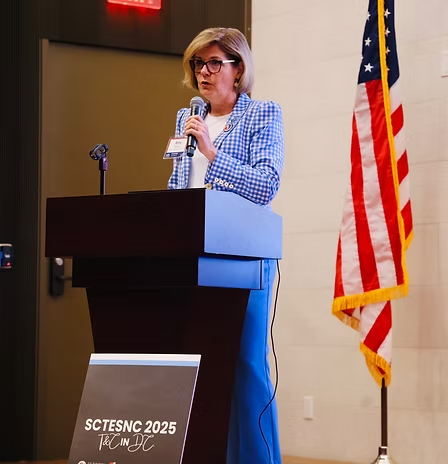
SJC Clerk Amy Rolfes Presenting at SCTESNC

The clerk’s office is a working operation of roughly 55 employees. When incumbent County Clerk Amy Rolfes took it over in 2023, she gave every employee a defined role, a written job description, and an annual performance review. Every clerk works from standard operating procedures that are reviewed each year, and employees are cross-trained to cover more than one job. More than $140,000 in grant money has gone into election security, cameras, motion detectors, and key-card access. In 2024, the state’s post-election audit of the county’s Presidential race came back at 99 percent confidence, the highest possible without a full hand recount. The U.S. Election Assistance Commission invited Rolfes to Washington, D.C., to explain how she accomplished this in St. Joseph County. The clerks of the region elected her president of the Northern District Clerk Association.

Government offices are supposed to run this way. Anyone who has stood in the wrong line at the wrong window knows how many do not. This one, by every documented measure, does. And that takes away the easiest campaign there is. Ball cannot run on cleaning up a mess, because there is no mess. The roles are defined and the procedures are written. The audit came back at 99 percent. Whoever wins in November inherits an office that already works.

Which brings the question back to Ball, the Democrat who wants the job. What would she do better?

Here is her answer, in her own words, on her campaign website. “We need a Clerk with real-life, lived experience who can lead with empathy,” she writes. “Too many of our neighbors are living paycheck-to-paycheck and are one bad day away from small claims court or an eviction or foreclosure notice. As Clerk, we will be efficient and transparent, while also remembering the human side of dealing with our court system.” In her campaign video, she talks about her years of counseling people through foreclosure and eviction, and about connecting them to resources.

Now set that answer next to the job.

When a landlord files an eviction, the clerk stamps it into the record. When a bank forecloses on a family, the clerk processes the paperwork that takes the house. The same stamps, the same speed, for the tenant and the landlord, for the family and the bank. The clerk does not counsel anyone and does not connect anyone to resources. The clerk is the one person in the courthouse required to have no side, because the moment the record-keeper picks a favorite, the record stops being trustworthy for everyone. A clerk who favors the sympathetic party isn’t being kind. She’s being unfair to the other party.

Ball’s answer is an advocate’s answer. Her counseling work was honorable, and somebody should do it. But it is not this job, and offered as the reason to hold this job, it misses the job entirely. She is not proposing to run the office more accurately. She has not said a word about accuracy. She is proposing to bring the office a heart, and the office is built, deliberately, on not having one.

Her own paperwork already told us how the accuracy would go. As I reported this month, the campaign finance report Ball filed to seek the office names her committee the “Committee to Ellect Stephanie Ball” and spells the county “St. Josepah,” and she carries a default judgment, still open, in the very court she wants to run, from a case she never answered. I will not re-argue those records here. They are public, and they speak to how accurate she is with sensitive records.

So the question stands, and it is the only question this race has. The Clerk’s office runs on precision and neutrality, and it is delivering both, with the procedures already written and the audit already passed. Ball proposes empathy. Empathy is a virtue in a counselor, a neighbor, or a friend. In the clerk’s chair it is a thumb on the scale.

What would Ball do better if elected County Clerk? She has not said. Her own words suggest she does not understand the office.

BAD CREDIT: Stephanie Ball wants to run the office that keeps St. Joseph County’s court records. One of those records is a judgment against her.

I spend a lot of time combing through St. Joseph County’s court records. It is where a certain kind of story lives, the kind that does not make the news but tells you something true about the people asking for our votes.

Here is one I found.

In January 2024, a debt buyer called Midland Credit Management sued a South Bend woman named Stephanie D. Ball over an unpaid Citibank credit card. She was served. She did not respond to the lawsuit. On March 20, 2024, a St. Joseph County magistrate entered a default judgment against Stephanie D. Ball for $5,628.05. As of this month, that judgment is still open on the Mycase.in.gov website, unpaid.

The Stephanie D. Ball named in that file lives at 1607 College Street in South Bend. So does the Stephanie D. Ball who filed this year to run for clerk of the St. Joseph Circuit Court. They are the same person. She is asking to run the office that maintains the default judgment with her name on it.

I want to be careful about what that does and does not mean, because it would be easy to be unfair here.

The clerk of the circuit court is not a judge. The clerk keeps the records, handles the money that moves through the courts, and runs the county’s elections. It is administrative work, and its entire value is accuracy. A debt, even one that ends in a judgment, is not a crime, and plenty of decent people have carried one. If the story were only that Stephanie Ball once fell behind on a credit card, I would not be writing this.

But it is not only that.

The card was opened in January 2019. Her last payment, $150, posted in March 2022. By early April the account was past due. On April 2, a charge from a Marriott in San Diego, CA posted to it. Nine days later came the late fee for the payment she had missed. The account defaulted, was charged off that October at $5,628.05, and was sold to Midland, which took her to court. She filed nothing in response, and so she lost by default.

I dwell on the “filed nothing” because of who Ball says she is. On her campaign website, she boasts she’s a “Certified Credit Counselor” and describes years of counseling homeowners through foreclosure at the South Bend Heritage Foundation, helping them file with the courts so they could be heard. She lists a certification as a financial counselor. She writes of neighbors “one bad day away from small claims court or an eviction or foreclosure notice.” She offers herself as the person who understands how the system works. The person who claims to have taught others to answer the court did not answer her own case.

Then I looked at the paperwork she filed to run for office, and it did not reassure me. Her campaign finance report names her committee the “Committee to Ellect Stephanie Ball.” It lists her county as “St. Josepah.” Some contributors are itemized with no addresses where the form asks for them. The entire form is sloppy and unprofessional. This is the report she filed to run the office where accuracy is paramount.

There is more, and it is not about her wallet.

Ball sat on the South Bend school board from 2019, when she was appointed, until 2024, when voters declined to keep her. She ran that last campaign promising to ask hard questions about money, to review the budget, to be, she wrote, “wise with the resources.” During her years on that board, a renovation of Brown Intermediate School that the board was told would cost $2.8 million ballooned to roughly $7.5 million, by the district’s own mismanagement. State auditors found the district skipped the bidding the law requires, and that the board’s minutes did not even document approval of the contracts. The project cost nearly tripled while Ball sat on the board promising vigilance.

She also went on camera in 2020 to campaign for the school referendum, introducing herself as the district’s representative and walking voters through the absentee ballot. It passed on June 2, 2020, and it raised property taxes throughout the district to fund $20.8 million a year for eight years and $54 million in bonds.
Ball persuaded her neighbors to vote for the SBCSC Referendum.
Her neighbors’ tax bills went up as a result.


Now in 2026 she wants a different office entirely. In 2024, she lost her campaign for school board. This year she is a candidate for county clerk. The jobs have little in common except that she receives a taxpayer funded salary.

I am not telling you how to vote. Ball may have answers for the default judgment, the errors, and the sudden change of office. Ask her for them. That is what a campaign is for.

I am telling you what Ball isn’t telling you. Stephanie Ball wants the job of maintaining St. Joseph County’s court records accurate and complete. One of those records is a judgment against her, unanswered and unpaid, two years and counting.

Hidden Costs of Parasitic Airbnb-Style Rentals in Our Community

When we open our homes to short-term renters, we do so with a sense of trust in the platform hosting us. But recent events across South Bend—from alarming late-night gunfire near neighborhood properties to parties getting wildly out of hand—have forced many of us to face a sobering reality. For neighborhoods like Sunnymeade and communities across our city, the current gap between corporate policy and real-world enforcement creates a safety loophole for which our neighbors are forced to pay.

As a local Airbnb host, I always believed the system worked. Like most hosts, I relied on the platform’s rules to keep my property and my community safe. But a closer look at how these platforms operate reveals a glaring safety blind spot: third-party bookings.

Airbnb explicitly prohibits booking a stay on behalf of someone else. Yet, in practice, this policy is treated like a suggestion. Because the platform does not require guests to verify their identities upon physical arrival—such as uploading a real-time photo matching their ID when checking in at the rental—there is absolutely no way to guarantee that the person who booked the home is one of the people staying on the premises. 

This oversight creates a dangerous loophole. It means individuals who would fail a basic background check, or who are registered sex offenders, can easily bypass platform restrictions simply by having an associate book the stay for them. When a platform fails to verify exactly who is entering a residential block, a quiet neighborhood can transform into a public safety hazard overnight. While South Bend Police still have not made arrests in the massive spray of bullets in the Sunnymeade neighborhood over the Easter weekend, we do know that the Airbnb-style rental there was the target. Shots lodged into rooftops, broke through homeowners’ windows, and damaged cars. We even have reason to believe that the unearthed fire hydrant in the 1200 block of Longfellow was caused by the shooter(s) as they fled the scene. 

We can no longer afford to let multi-billion-dollar platforms offload their liability onto South Bend neighborhoods. We must consider forcing Airbnb to actively enforce its own safety policies. If the company refuses to implement common-sense biometric or photo verification at check-in, our local city leaders and police department must step in, and local taxpayers should not carry this burden. Property rules should be backed by local enforcement, treating repeated unverified bookings as code violations or public nuisances.

Compounding this safety issue is a frustrating economic double standard. While neighbors bear the physical risks of unverified renters, local hosts bear the financial brunt of the platform’s increasingly guest-friendly cancellation policies.

In a town like South Bend, our entire seasonal rental economy is tied to Notre Dame’s success. If the team suffers a tough loss early in the season, the momentum changes instantly. The new, more renter-friendly cancellation policies mean hosts bear the economic hit when fans change their travel plans. Because the platform consistently prioritizes the renter’s flexibility over the host’s baseline security, local property owners are left holding empty calendars and completely wiped-out revenue with zero recourse.

Short-term rentals can absolutely be an asset to South Bend, providing vital lodging during peak university weekends and bringing tourism dollars into our local economy. But the current setup is fundamentally unfair. Neighbors should not have to worry about the identities of those staying next door, and hosts should not have to carry all the financial risk of an unpredictable, NIL-fueled football season. 

It is time for our Common Council in South Bend and city governments around the nation to demand that short-term rental platforms start protecting the communities that make this parasitic business model possible in the first place.


© 2026 Brian S Collier. All opinions are those of the author. The author reserves all Rights and copyrights. To request permission to reprint any or all of this article, contact info@redresssouthbend.com

Author’s Note: This story was partially written using AI assistance, but all reporting, local details, and interviews are real, original, and strictly fact checked.

Reprinted with permission of the author by Redress South Bend.

All opinions, research, and views in this piece are attributed to the author and are not necessarily the thoughts or opinions of Redress South Bend.

A Beautiful Patio to Watch the Most Beautiful Games

For years, I’ve known that the food at Chimichurri is something special. In fact, a few years ago, a former priestly boss of mine, who was a bit of a foodie, used to explicitly send us out to pick up their incredible, authentic Argentine food. The great food and wonderful customer service at this place even overcomes having one of the worst days in my life getting some hard news at this place – that’s how good it is, their food and service can even overcome personal tragedy!

From those perfectly folded empanadas to the vibrant flavors they consistently serve up at 601 East Jefferson Boulevard in South Bend, just across from Howard Park, the Chimichurri stand has been one of the great food spots in our Howard Park area, and this summer, it’s gotten even better!

Over the last few weeks, as I walked through Howard Park and past the Chimichurri stand, I wondered why the owner was building a patio by hand, since he already had a hot spot and didn’t need to do any renovations. I watched the owners out front with tools in hand, working through the cold spring days and, on a few hot, humid days, building the outdoor addition; they were measuring, sawing, and hammering every single board themselves. For days, I couldn’t quite figure out exactly what the master plan was—until the very last day of construction.

That was when the massive outdoor big-screen television was secured in place.

This gorgeous new patio wasn’t just a renovation project; it was a total labor of love built entirely by hand for our community. They built it so South Bend has a vibrant, welcoming place to gather, eat incredible food, and watch the World Cup matches together this summer. And, the movie adage has been true: if you build it, they will come!

I was out there last Friday with a great crowd for the Brazil vs. Haiti game, watching Brazil best Haiti 3 – 0. Sitting there among the fans from both teams, I couldn’t help but think about how the rest of the world gets to watch the World Cup in community—sharing the highs, the lows, and the pure energy of the game together. Now, thanks to this great outdoor venue, we can finally do that right here in South Bend.

The owners shared that while they’ll be cheering loudly for both Argentina and the USA, absolutely everyone is welcome to join the crowd. Whether you are coming to dive into a plate of hot food, grab a cold ice cream, or just soak in the match-day energy, the patio is ready. Even better? For the evening games, they’ve teamed up with their neighbors at the Cat Lady Cafe, meaning beer and wine will be available for purchase right there to pair with your meal.

Visit https://www.chimichurrisb.com/ to check out the great, affordable menu (the Ice Cream menu is in the shop and changes regularly) and plan your next match-day visit.

Since the United States is co-hosting this massive tournament, you can watch this quick explainer video from Al Jazeera English to see exactly how the new 48-team expansion works: https://www.youtube.com/watch?v=Ak30dLNw7zU.

To help clear up the math as you watch the bracket take shape: during the initial group stage, teams are awarded three points for a win, one point for a draw, and zero points for a loss. Under this year’s new format, the 48 teams are divided into 12 groups of four. The top two teams from each group, along with the eight best third-place finishers, will advance into a brand-new 32-team knockout bracket on their way to the finals.

It’s local business at its absolute best—built by hand, fueled by passion, and ready for a massive summer of soccer.

See you on the patio for World Cup matches or just enjoying this expanded outdoor eating area in the heart of the Howard Park district.


© 2026 Brian S Collier. All opinions are those of the author. The author reserves all Rights and copyrights. To request permission to reprint any or all of this article, contact info@redresssouthbend.com.

Author’s Note: This story was partially written using AI assistance, but all reporting, local details, and interviews are real, original, and strictly fact-checked.

Note: Image is a composite rendition and not the actual addition to the patio.

Reprinted with permission of the author by Redress South Bend.

All opinions, research, and views in this piece are attributed to the author and are not necessarily the thoughts or opinions of Redress South Bend.

Police tapes: Chief Boykins found no evidence of crimes or racism by officers

Chief Darryl Boykins signed a document in 2013 saying he was aware of no evidence of illegal activity by the police officers whose calls were captured on the department’s wiretapped line, and no evidence they had used a racist word against him. This admission has sat in the case record ever since. Now after the city has lost its fourteen-year fight over the police tapes and spent more than three million taxpayer dollars, South Bend’s Common Council is weighing whether to appeal anyway.

The case began with a single telephone line, the line ending in 6031. Around 2004, a captain named Rick Bishop asked to have his line recorded after he received threatening calls. He consented to the recording of his own conversations, and that recording was lawful. A person may agree to have his own calls recorded.

Bishop changed offices in 2010, and the line did not follow him. It moved to the desk of Captain Brian Young, who used it without being told it was recorded. Every call he made on it was recorded. Young did not consent, and neither did the people who called him.

In early 2011, the department’s communications director, Karen DePaepe, was troubleshooting the recording system when she heard Young’s voice on a line she believed belonged to someone else. She kept listening. At the direction of then-Chief Boykins, she copied nine conversations onto five cassette tapes. A federal investigation followed. Boykins was demoted. DePaepe was fired. In 2012, the Common Council subpoenaed the recordings, demanding to know what was on them.

The City refused to release them without a court order, and the officers whose voices had been captured went to court to keep them sealed. One question remains in the fourteen years since: were the recordings legal? They were not, and the reasoning is the heart of the case.

Wiretap law, state and federal, forbids recording private conversations without consent or a warrant. The recording of 6031 began with Bishop’s consent, but that consent was his, not the phone number’s, and it did not pass to whoever inherited the line. Once Young inherited the line, no one on the line had agreed to be recorded, and no warrant covered it. The City could have claimed the recordings were made in the ordinary course of business, as a department that records all its lines by routine may, but South Bend did not record individual officers’ lines by routine. It only recorded them when an officer asked. Young never asked.

On May 28, 2026, Judge Jamie C. Woods ruled that the recordings violated both the Indiana Wiretap Act and the Federal Wiretap Act. Woods found the department had known the line was recorded the entire time, that Boykins reviewed the list of recorded lines every year, and that the line 6031 continued to be recorded without Young’s consent. Judge Woods ordered that the tapes be destroyed and barred the City, the Council, and any administration that follows from disclosing them, using them, or referring to them in any proceeding. The destruction is stayed while any appeal is pending.

That is the ruling the Council may appeal. Before it spends more to do so, the public it represents should know what the recordings produced.

They produced nothing. For years, the tapes have been described by some as holding misconduct. Federal prosecutors reviewed the matter in 2012 and brought no charges. A special prosecutor reviewed it again in 2015 and brought none. And DePaepe, the one person who listened to the tapes and copied them, testified under oath to what came of them. No criminal charges against any officer. No Internal Affairs charges. No discipline. No demotion. The only two people who lost anything were DePaepe, who lost her job, and Boykins, who lost his rank. She testified that several of the men long tied to the case, Tim Corbett among them, were not on the cassettes at all.

Transcript excerpt of a cross-examination involving a witness named Karen Depaepe, discussing individuals not present in recorded phone conversations.

Boykins answered the same question with his signature. In the November 2013 settlement of his own lawsuit, he and the City stated together that neither was aware of any evidence the recorded officers had done anything illegal, or any evidence they had used a racist word against him. He also represented that he held no copies of the recordings, and no transcripts or notes drawn from them. He signed it on November 12, 2013. The City paid him and his attorney seventy-five thousand dollars to reach the agreement.

Legal document outlining the terms of a settlement agreement between parties, including payment schedules and dismissal of lawsuits.

The cost is a matter of record, and it has climbed for years. By early 2015, the litigation had cost taxpayers around 1.6 million dollars in legal fees and settlements. By early 2019, the figure neared two million. Both totals came before the case reached the Indiana Court of Appeals, before the state Supreme Court declined to hear it, before it resumed in 2023, and before last December’s trial. I am told the total now exceeds three million dollars.

The spending was a series of choices, made in the open. In January 2019, after a judge urged the parties to make an extraordinary effort to settle, the Council voted nine to nothing to reject any agreement mediation might produce. It chose to keep fighting. The bill has grown since.

No one would have authorized this lawsuit in 2012 had they been told it would one day cost twenty million dollars. The figure is absurd, and its absurdity makes the point: somewhere below twenty million dollars lies a number the public would also have refused, a line past which the cost outruns the cause. What is the limit? Ten million? Five million? Four million? The total has crossed three million dollars. The Council has never named its limit, and the taxpayers funding the lawsuit have never been asked theirs.

An appeal will most likely not change where the tapes are headed. A judgment built on a trial judge’s findings of fact is difficult to overturn, because appellate courts do not reweigh the evidence and reverse a trial judge only when he is plainly wrong. 

The Council met in executive session on June 3 to weigh its next step. Council President Canneth Lee has said the ruling disappointed him and that he is considering what comes next. The public that has paid for fourteen years of this was not in the room or consulted.

Fourteen years. More than three million dollars. Nothing suggests another million dollars would change the outcome, or reveal anything the chief at the center of it did not already disclaim, in writing, more than a decade ago.

Diego Morales passed the GOP’s loyalty test. Party leaders want him out anyway.

Diego Morales did the things the Republican Party rewards. He endorsed Donald Trump, and says he was the first Republican Secretary of State in the country to do it. He defended Trump’s name on the ballot. He campaigned for the president’s allies. He won his statewide seat at the 2022 convention, beat the democrat in the general election, and ran his office the way the party’s national leaders said an office like his should be run. In the Republican Party of 2026, that is the whole job description.

Now the party’s own leaders in Indiana are trying to take the seat away from him.

Indiana Republicans choose their nominee for Secretary of State at a state convention rather than a primary. Candidates file, delegates gather, and the delegates decide. This year, just before the filing window closed, a Senate staffer named Max Engling entered the race. Within days, three of the most powerful Republicans in the state moved in to endorse Engling. U.S. Sen. Jim Banks withdrew his endorsement of Morales. Attorney General Todd Rokita withdrew his and asked Morales to suspend his campaign. State Treasurer Daniel Elliott went the furthest and called on Morales to resign, saying the secretary “no longer reflects our values and is a weight on our ticket.”

Set Trump aside for a second, however you feel about him, because the point does not depend on it. Trump is the Republican Party right now. He sets the GOP’s direction and decides what the word “Republican” is worth in a convention hall. There is no space between the president and the establishment. They are the same thing. And the record shows Morales standing inside that line for years, not at the edge of it.

The record is his own, posted under his own name. In January 2024, Morales backed an amicus brief arguing that Secretaries of State could not strike Trump from the ballot under the Fourteenth Amendment. That March, Morales rallied with Donald Trump Jr. and endorsed both Trump and Banks, the senator who would later turn on him. That September, Morales posted a photo with the president and called himself a legal immigrant and proud Latino who proudly endorsed him. In April 2025, Morales stood outside the White House and wrote that the president “has a partner in the Indiana Secretary of State’s office,” and that month his office issued a release backing Trump’s executive order on election integrity. The Heritage Foundation, which has graded state election laws since 2021, ranks Indiana seventh in the nation on its Election Integrity Scorecard and counts it among only four states to post double-digit gains in that time.

Morales reads the move against him through that same lens. In a text to delegates, he called it “political retribution for me standing with our great President against those who fiercely opposed him.” Take the claim for what it is, his own. It still sharpens the question the rest of us are left asking.

Because the question almost asks itself. If a man does all of that and still gets called a weight on the ticket, what exactly was the test, and who decides when you have passed it.

In Indiana, the answer to the second part is not Banks, and not Rokita, and not Elliott. It is the delegates. On June 20, roughly 1,800 of them will gather at the Grand Wayne Convention Center in Fort Wayne and pick the nominee themselves.

Those delegates have overruled the party’s heavyweights before, and recently. I wrote last week about how they picked Morales in 2022 over the establishment’s choice, and how in 2024 they chose Micah Beckwith for lieutenant governor over a running mate backed by both the governor and the president of the United States, 891 to 828. The pressure this year is lighter than that, and it is aimed at a man those same delegates already elected.

Braun, alone among the heavyweights, has stayed out of the push against Morales. He also stood where these delegates will stand and watched a favorite lose. He told reporters that he respects the process.

The leadership is free to decide that it picked wrong in 2022. What it cannot do is define loyalty for years, watch Morales meet every part of the definition, and then treat his meeting it as beside the point. Either the test meant something or it did not. On June 20, the people who administered the loyalty test the first time get to say which.